
This is Part 1 in a series on The Sustenance System—a design for companies that want to endure in the AI era.
Many Corporations Are Beholden to a System of Consumption.
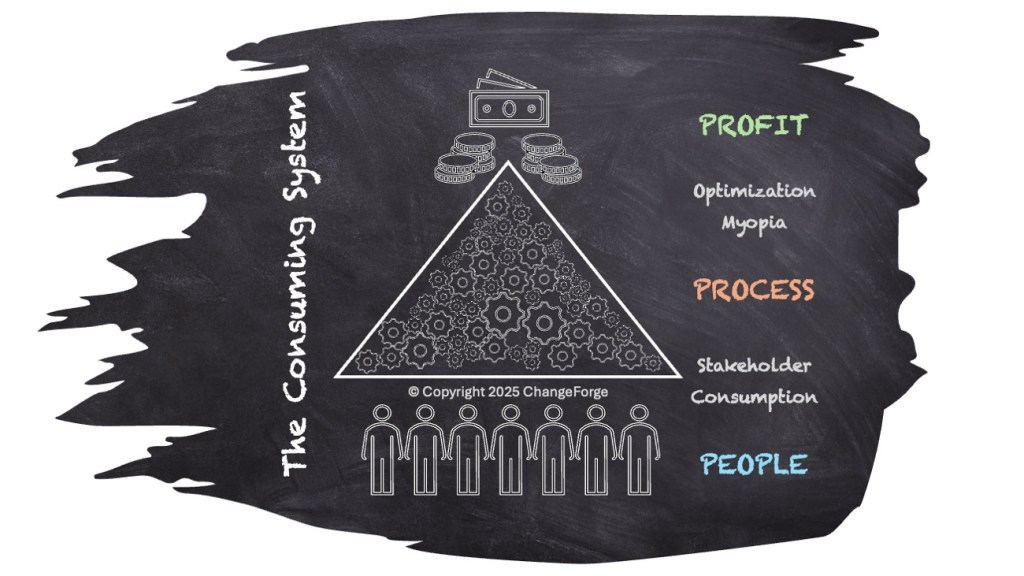
More than a philosophical statement, corporations suffer from an operational addiction exposing the real hierarchy of modern enterprise:
- People at the bottom: interchangeable inputs.
- Process in the middle: mechanized obedience.
- Profit at the top: sacred, untouchable, worshipped.
This isn’t just bad design; it’s extractive logic masquerading as operational excellence.
‘The Consuming System’
The system of consumption is tuned for a burn rate running on:
- Optimization: as a polite phrase bordering on exploitation.
- Myopia: as a cultural operating principle.
- Stakeholder consumption: measuring value by caloric output.
This is profit-as-god, and process as its priesthood. In this religion, process subdues soul of the collective while people are leveraged at the pulpit of technology. Bring your sacrificial offerings to our temple and feed the hungry god.
Behind the curtain, we know what levers truly drive decisions:
- Headcount is a cost.
- Process is a control system.
- And profit sits on the throne.
This isn’t cynicism. It’s the architecture.
We’re optimizing ourselves into exhaustion.
- More productive with less time.
- More intelligence with less wisdom.
- More communications with less connection.
The Consuming System was broken before. Now we want to overlay GenAI to amplify its effect.
We’ve built a machine that rewards output, not outcomes.
- People are treated as inputs: Judged by KPIs that have nothing to do with actual impact.
- Processes are designed for scale, not systemic sense: We automate myopically before we understand holistically.
- Profit is the unquestioned endpoint: The machivellian scoreboard that justifies the harm along the way.
We call it performance. But what we’ve created is a consumption engine—one that burns through people, profits, and value at an unsustainable rate.
We’re so focused evolution, we risk extinguishing our purpose.
And the cruelest irony?
The more we feed it, the less we connected we feel–to one another, to our teams, to our customers.
The more we optimize it, the more brittle it becomes.
From Consumption to Sustenance
Here’s what changed for me:
I stopped asking, “How do we make this system work better?”
And started asking, “What if this is the wrong system entirely?”
What if the problem isn’t that we’re underperforming?
What if we designed the system for sustenance rather than consumption?
Same components: people, process, profit.
Radically different perspective.
The consuming system extracts.
The sustaining system replenishes.
One asks, “What can we get from them?”
The other asks, “What enables them to give?”
‘The Sustenance System’
The real problem isn’t operational. It’s philosophical.
We’ve architected our businesses around a false hierarchy:
Profit > Process > People
That’s not strategy. That’s surrender.
It reduces humans to throughput, and wisdom to latency.
So what’s the shift?
Let’s flip the moral physics of an enterprise.
People → Process → Profit
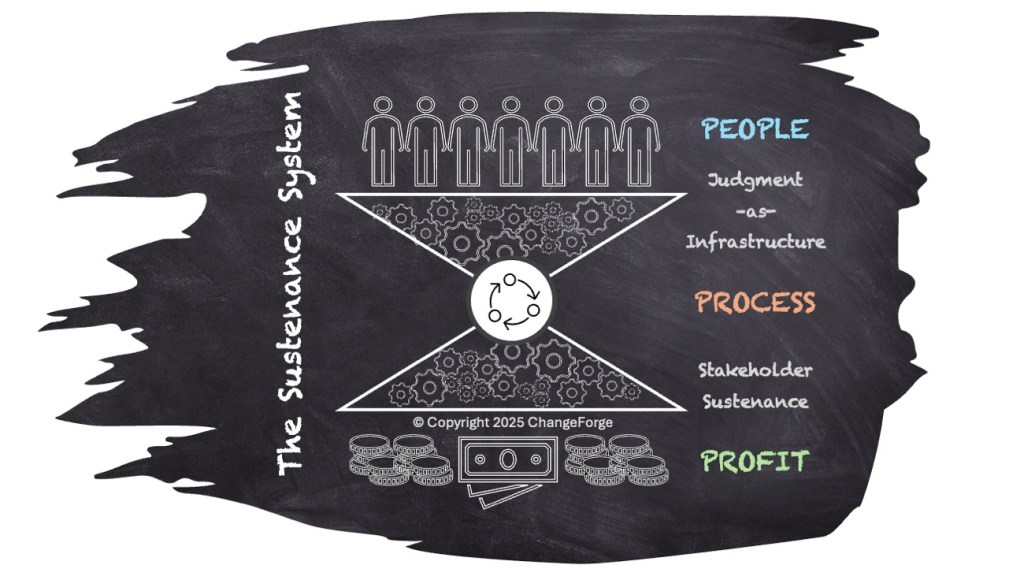
- People at the top: not resources, but reasons. Not just doing the work, but shaping the reason the work is done.
- Process as infrastructure: not automation-for-its-own-sake, but judgment scaled and sustained.
- Profit at the base: not the point, but the byproduct. Profit isn’t just measuring success; it validates alignment to organizational purpose.
This isn’t just a values shift. It’s a functional re-architecture. Profit doesn’t go away; it becomes evidence of alignment, not exploitation.
You’ve moved from:
“How do we squeeze more from what we have?”
to
“How do we sustain what creates value in the first place?”This isn’t just more human. It’s more durable.
Because in a world of compounding complexity, sustenance scales better than consumption.
Judgment-as-Infrastructure is the cornerstone. Every consumption-based system treats judgment as friction. In the sustenance model, judgment becomes the operating system.
Principles of Design for the Sustenance System
Here are five truths I’m building around:
- People aren’t resources, they’re sources of purpose.
Invest in what creates purpose, not just what offers capacity. - Judgment-as-Infrastructure.
Build systems of people, process, and platforms that learn, not just systems that execute. - Profit is a byproduct, not a purpose.
Chase alignment, and profit follows. Chase profit, and entropy is inevitable. - Measure growth by what you reinvest, not what you churn. Investment is leading; churn, while important, is lagging.
- Adaptability grounded in meaning is your real competitive advantage. Efficiency is not the enemy, but it’s not the savior either.
Two Questions:
If you’ve made it this far, you are in one of two camps:
- You agree and are asking, “How do I put this in motion with my career or my company?”
- You’re skeptical but quietly asking “What’s the best path for my career or my company in an uncertain future?”
Either way, the reckoning’s underway.
Strip away the mission statements. Forget the hallway posters.
Look at how decisions are made. What gets rewarded. Who’s still standing.
The middle ground will give way to choosing a side.
Generative AI is being deployed to optimize for consumption.
But the companies that will thrive are designing systems for Regenerative AI–where judgment drives, value sustains, and people become multipliers, not margins.
IBM may have gotten it right–after getting it wrong. Others won’t be so lucky.
So here’s your real question:
Is your company built to consume or to endure?
If you’re exploring what Regenerative AI strategy actually looks like inside your business, let’s talk.
Reach out. No slide decks or sales pitches. Just real conversations about what comes next and what you’re actually building toward.


Leave a Reply